
Godot 4.6 is here, marking another significant update for the engine. The release is once again the result of contributions from hundreds of developers, with nearly 400 contributors submitting more than 2,000 updates over roughly four months since the previous release.
According to the development team, the stability achieved over the previous Godot 4 releases has enabled a shift into a new development phase. Godot 4.6 marks the beginning of this phase, which emphasizes polish, quality-of-life improvements, closer integration of industry standards, and continued performance optimization.
With this release, the Godot team aims to further establish the engine as a reliable choice for serious projects, while preserving its lightweight design, fast iteration, and flexibility.
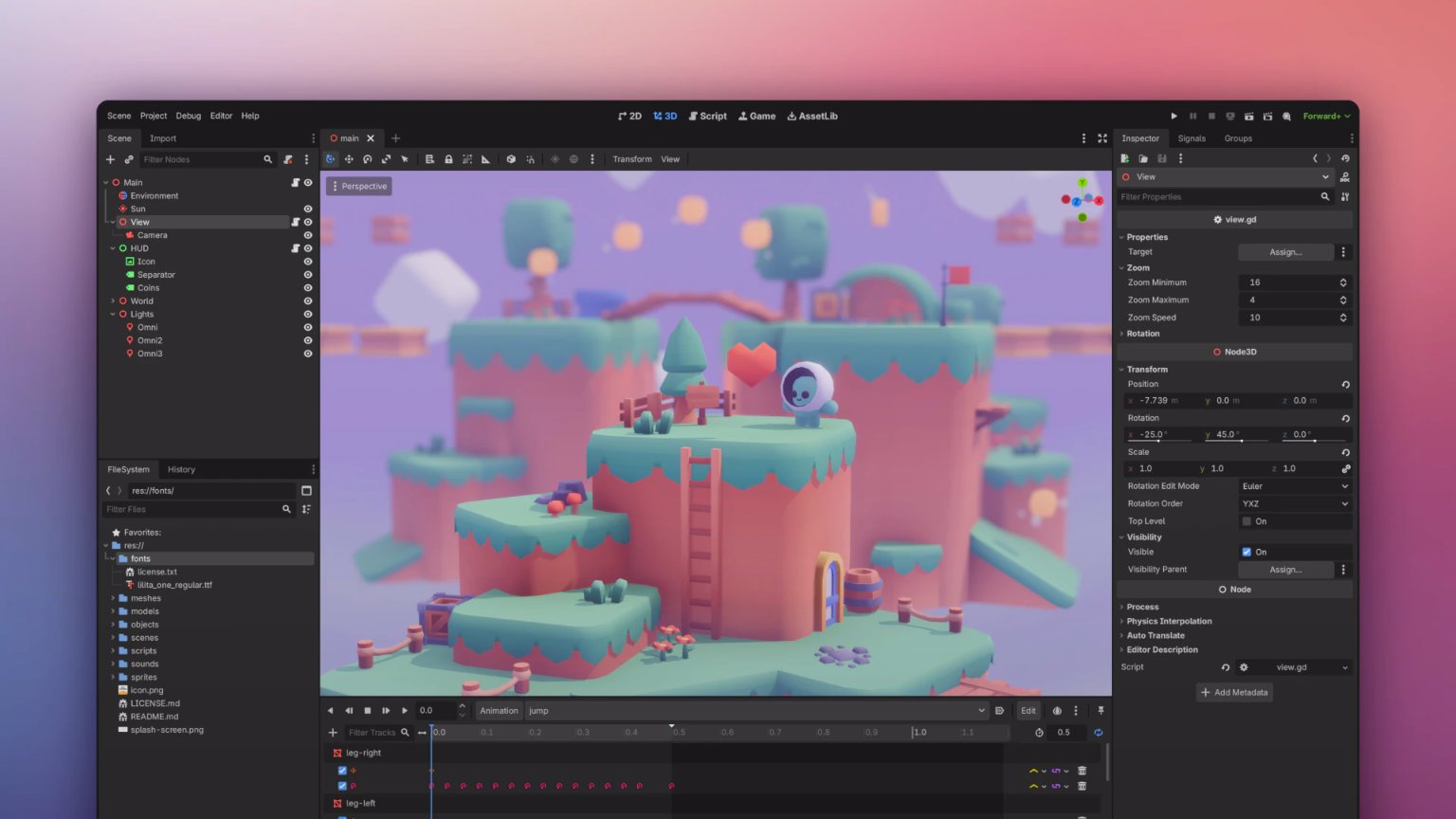
Highlights of this release include a new “modern” default editor theme. First introduced last year as the “Godot Minimal Theme”, it quickly became a fan favorite and is now the default.
Speaking of defaults, Jolt Physics, a standalone physics engine used in AAA titles, first introduced as an experimental option in Godot 4.4, is now the default physics engine.
The entire docking system has been unified, with bottom panels now behaving as regular docks. Docks can be dragged and dropped, moved between the sides and the bottom of the editor, and most of them can now be floated.
There is also a brand new IK (Inverse Kinematics) framework offering a full suite of modifiers and constraints. This framework allows users to decide where the endpoint goes while the bone chain follows naturally. It also supports combining IK with other modifiers and constraints, making it possible to fine-tune procedural animations directly in the engine.
Another major improvement is related to Screen Space Reflections (SSR). The functionality has been completely revamped, resulting in significant improvements to realism, visual stability, and performance. Reflective surfaces now look more realistic, with better handling of roughness and improved performance.
A less flashy feature, but a significant change, is the ability to use Godot as a library. The engine can now be embedded into other applications, allowing them to access and make use of Godot features under the hood, in a way similar to existing libraries such as SDL.
There are also multiple improvements related to workflow. One example is the decoupling of select and transform modes, with a new select-only mode that enables selecting nodes without displaying the transform gizmo.
Resources can now be dragged to other editor tabs, with the editor automatically switching to the target tab to allow dropping the resource in the appropriate place.
The Quick Open dialog now features live previews, with the selected resource instantly previewed in the scene while navigating the list.
Other additions include configurable AgX tonemapper parameters, improved glow blending defaults where glow is now blended before tonemapping, and material debanding for 3D on mobile, enabling higher visual fidelity for projects targeting these platforms.
In addition, Godot now defaults to Direct3D 12 on Windows, and the GDExtension interface is now defined in JSON instead of a C header, making it much easier for tools, scripts, and language bindings to read, analyze, and work with the API automatically.
The update also includes the ability to turn meshes into collision shapes and the ability to step out of functions with the new Step Out button in the script debugger.
There are numerous other new features, improvements, and bug fixes in this release. For more information, be sure to check out the official release page.