
The O3DE game engine has received a new update (26.05.0). This latest release continues the project's focus on improving engine stability while enhancing the user experience across its toolset. O3DE has seen steady improvements in reliability across recent updates, and this release appears to continue that trend, further strengthening its appeal for professional projects.
The update also brings O3DE closer to a turnkey solution, narrowing the gap with more established engines through the introduction of a particle system. The Open Particle System is a new Gem (O3DE's term for engine plug-ins) designed for creating particle effects. The system includes a dedicated editor for previewing effects during creation, several sample projects showcasing its capabilities, and a simulation runtime directly integrated with the Atom renderer. It currently supports three particle types (sprite, ribbon, and mesh), while a variety of modules can be used to influence behavior, including color, force, and speed.
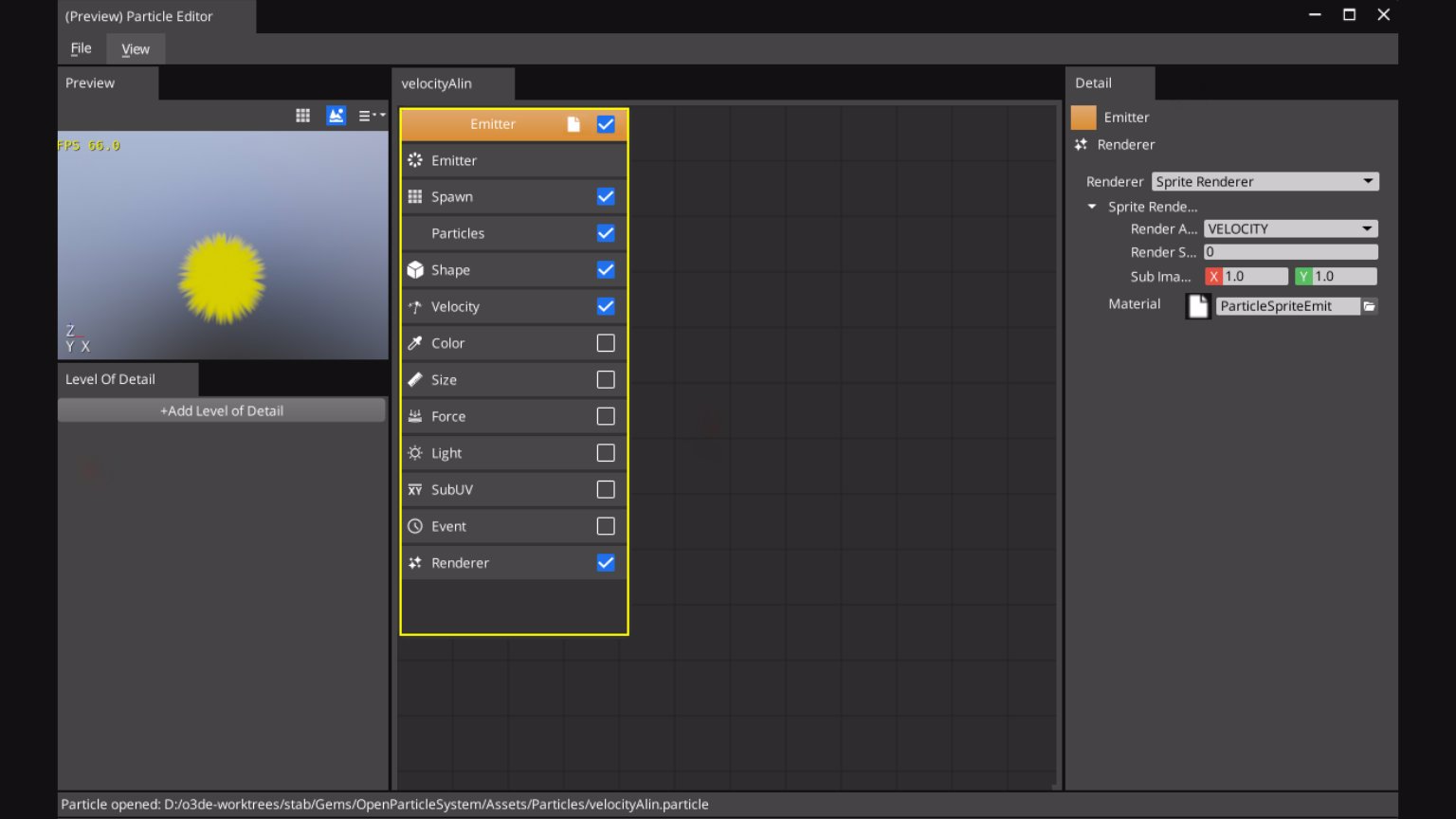
Although a notable new feature, the particle system remains experimental, and its use in production is currently discouraged. The feature may be subject to significant changes as development continues, while additional capabilities may also be introduced.
Another significant addition is a new graphical tool that simplifies the creation of C++ components directly from the editor. This feature eliminates the need to access the command-line interface (CLI) or manually duplicate existing files. Instead, the tool handles the entire scaffolding process, including generating header and source files and registering them with the build system.
Other highlights of this release include the ability to automatically generate levels of detail (LODs) for imported FBX models. The feature must be enabled manually and is intended to facilitate scene prototyping by generating missing LODs during the import process.
The Display Mapper component has also been expanded with additional tone mapping options, including four AgX variants (Standard, Golden, Punchy, and Warm) as well as Khronos PBR Neutral.
A less flashy but important addition is the return of the initial entity state option to the Inspector panel. While the feature existed in previous releases, it has now been restored and expanded. Activation states can now automatically propagate to all descendant entities, enabling full activation or deactivation of an entire hierarchy. Developers can also fine-tune this behavior through a bitmask system, providing greater control over when child entities should be activated.
Other changes in this release include the adoption of PhysX 5 as the default physics backend, with PhysX 4 now being deprecated. A new asset management feature also allows developers to opt into automatic asset bundling for generic asset types, including dependency registration and binary conversion for improved loading performance.
The release also includes updates for robotics, another key area of focus for the project, along with numerous additional improvements and bug fixes.
For more information, be sure to visit the official release notes.